


A platform can count every post it removes. It can report how it classified those posts and how quickly it acted. But when Ofcom asked for exposure data, two providers couldn’t tell it how many UK users under 18 had seen the content they acted on.
That’s the difference between tracking what a safety team did and measuring what users experienced.
Ofcom is the UK’s communications regulator. Under the Online Safety Act, it oversees safety duties for social media platforms, search services, and other regulated services used in the UK. Three recent developments show what that oversight looks like in practice.
October 22—the report
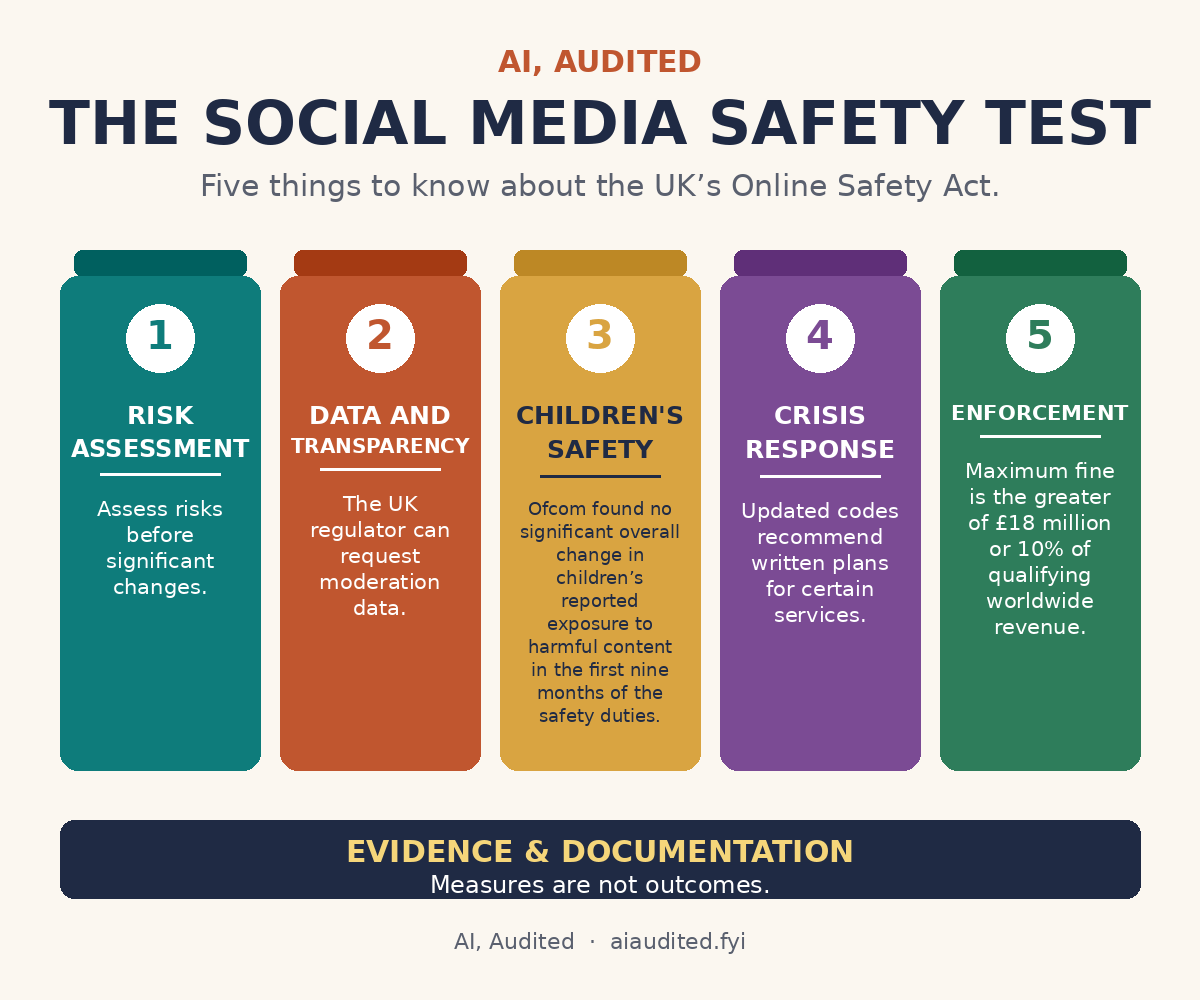
Ofcom published its first statutory report on content harmful to children under section 63 of the Act. It found no statistically significant change overall in children’s self-reported exposure to harmful content over the first nine months after the children’s safety duties took effect in July 2025.
In an earlier Ofcom survey, 73% of 11- to 17-year-olds recalled encountering at least one type of harmful content from a list in the previous four weeks. Among respondents asked about one encounter, 35% said they came across it in their feed, and 1% said they found it by searching.
The report looks at how often children encounter harmful content and how serious the harm can be. Whether individual services are complying with their duties and whether the measures in Ofcom’s codes are effective are separate questions. Ofcom recommended adding body stigma content and depression content to the Act’s priority category for content harmful to children.
October 30—the court case
The High Court rejected challenges by Meta, WhatsApp, X and TikTok to Ofcom’s information notices. Ofcom issued the notices in February 2026 under section 100 of the Act, seeking data on moderation, user reports, appeals, and UK users’ exposure to content the platforms took action on. The requests covered data going back to January 2024, with three submission deadlines in June 2026, September 2026, and March 2027.
The court refused permission to proceed on seven grounds and rejected the proportionality and human rights challenges on their merits. The ruling confirms that Ofcom can require information for legitimate regulatory purposes such as monitoring and research.
The October 22 report already drew on data collected under the February notices, alongside Ofcom’s survey and other research. The survey showed little overall change in reported exposure. The platform data showed how hard it can be to measure that exposure consistently, even when services can count the content they acted on. The next batch of data, due March 25, 2027, will give Ofcom another period to track.
November 2—the codes
Updated Ofcom codes for user-to-user services took effect, adding crisis response measures. The codes recommend written protocols for large services at medium risk and for services of any size at high risk for specified illegal harms or for specified types of content harmful to children. The children’s code applies to services that children are likely to access.
A protocol should spell out which signals the provider monitors, who responds, and how the team acts. Providers should conduct and record a review when the crisis ends or 90 days after it began, whichever comes first. The codes also recommend a dedicated law enforcement contact channel for certain large services during a crisis. Providers can use and document alternative measures that meet the underlying legal duties.
What this means if you run a service in scope
Make your data retrievable. Ofcom can ask for operational data as part of routine monitoring and research. The January 2024 lookback applied to these specific notices. Keep the records behind moderation, complaints and appeals timestamped, reconcilable and easy to produce.
Rehearse the crisis protocol. Run a tabletop exercise before you need it. Record who made each decision, where the response stalled and what you changed afterward.
Report exposure alongside activity. A removal count tells you how much content your team acted on. Time to action shows how quickly your team acted. Exposure tells you how many users saw it before the action took effect.
Assess risks before significant changes. Ofcom is investigating whether Meta adequately assessed the risks before launching Instagram Instants in May 2026. The investigation is ongoing. Build the risk assessment into the launch process so the team can act on it before release.
What to watch
March 25, 2027. The third batch of data requested under February notices is due.
The fees case. Meta’s separate challenge to Ofcom’s method for calculating supervision fees and maximum penalties was heard October 13–14. The statutory maximum is the greater of £18 million or 10% of qualifying worldwide revenue.
Category 1 appeals. Meta is challenging the Category 1 designations for Instagram and WhatsApp. That designation carries additional duties.
The under-16s ban. The UK government plans to restrict under-16s’ access to certain social media services from spring 2027.
If the UK asked for the receipts tomorrow, what would yours prove?
Sources
High Court judgment on Ofcom’s information notices, October 30
Ofcom’s October 22 report on content harmful to children, including Annex 2
Ofcom’s crisis response statement and amendments to both codes
High Court scheduling order for the fees case and Reuters coverage of the hearing
UK government fact sheet on the planned under-16s restrictions