


Explore the interactive framework
AI, Audited’s Five-Pillar AI Literacy Framework (Newsletter Issue #002)
A proposed practitioner standard for Article 4 of the EU AI Act. Article 4 still obliges providers and deployers to take measures on AI literacy. Under the Digital Omnibus amendments reflected in current Commission guidance, a specific “sufficient level” is no longer mandated — the 2024 position is summarized in the full edition as the historical record. Start with the European Commission’s official Article 4 guidance; what follows is ours. Subscribe free to AI, Audited
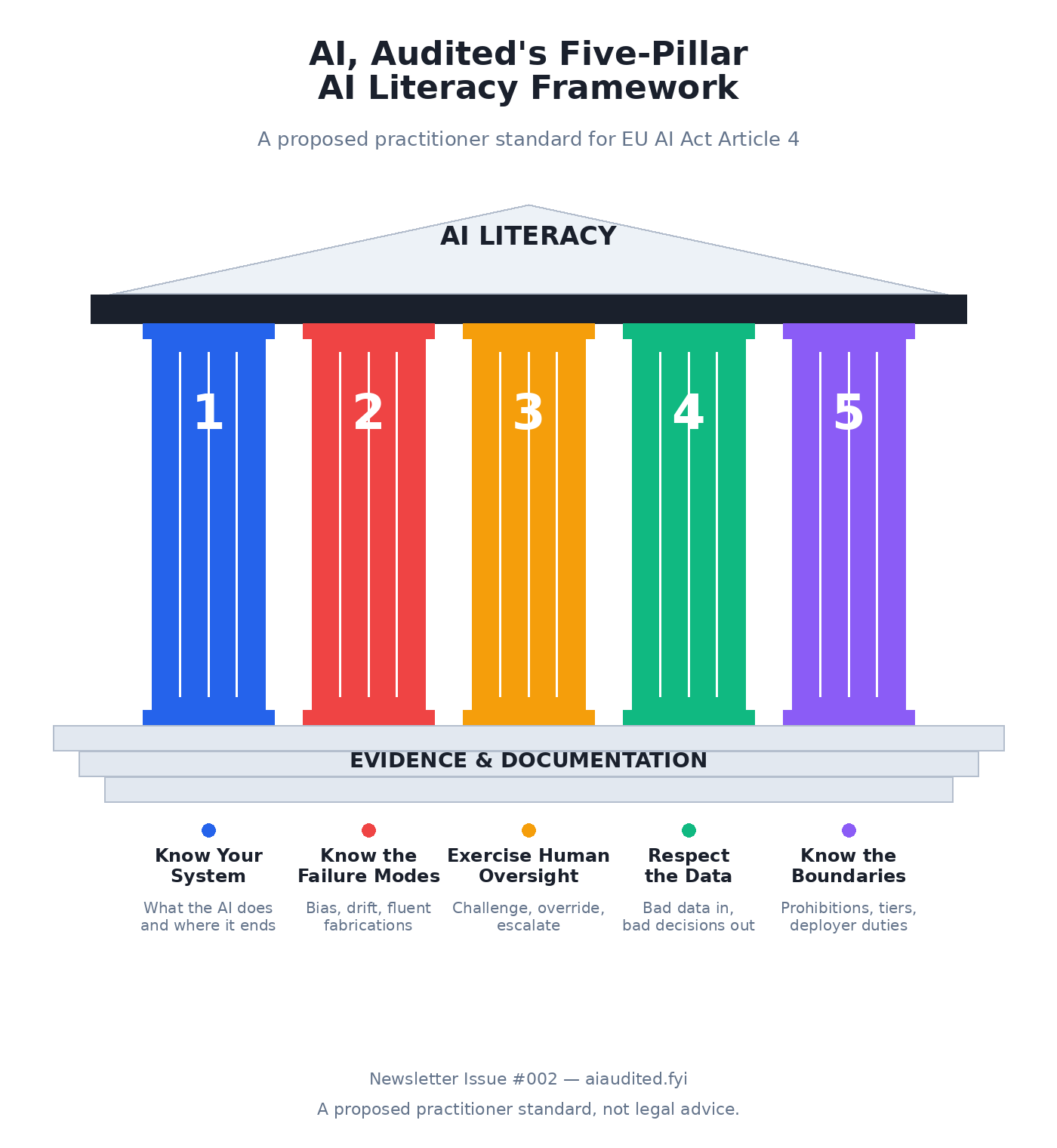
The five pillars
Know Your System. What the AI in front of you actually does — and where its competence ends. In practice: the system’s purpose in one plain sentence, how outputs are produced (probabilistic, not authoritative), the tasks it is not validated for, and version awareness.
Know the Failure Modes. Bias from skewed training data, silent drift, and — in generative systems — fluent fabrications; plus automation bias, the human failure to question a confident-looking output. In practice: learn your own tools’ failure patterns before they reach a decision.
Exercise Human Oversight. Article 14 requires high-risk systems to be designed for effective human oversight; Article 26 sets the deployer’s duties — use as instructed, assign competent oversight, monitor, report serious incidents. In practice: trigger points for review, how to interrogate an output, override authority, blameless escalation.
Respect the Data. Behavior is set by the data behind the system—training data, and whatever it keeps ingesting. In practice: “bad data in, bad decisions out” at working depth; provenance, lineage, and drift discipline at technical depth.
Know the Boundaries. The legal perimeter: prohibited practices, risk tiers set by use case (not by model), deployer duties, and affected persons’ rights to explanation and redress.
Depth by role
Hands on the system (operators — recruiters, analysts, support agents): all five pillars at working depth.
Hands in the system (developers, data scientists, engineers): working depth plus technical data provenance and oversight engineering.
Hands on the wheel (executives, legal, risk, compliance): the governance reading of every pillar.
Worked scenario: the challenged rejection
A screening tool auto-rejects a strong candidate over a two-year employment gap, citing only “profile fit.” The recruiter checks the system briefing (known failure mode: penalising non-linear careers), re-reads the CV, finds contract work the parser missed, and overrides the rejection. Recorded: tool output and model version, the override with its reason, an auditable decision trail, and a failure-mode register entry. Remediation: vendor queried, similar rejections re-screened, briefing updated, the anonymised case added to refresher training.
Evidence checklist
Role-to-pillar curriculum map
Completion and currency records
Assessment results — scenario-based; an assessment provides evidence of applied understanding
One-page briefing per AI system in production
Refresh and incident log
Recommended practice (not law)
The Act prescribes no cadence. Our recommendations: baseline training before unsupervised use of any AI system, a refresher every 12 months, event-driven briefings when a system changes or an incident occurs, and scenario assessments at each cycle.
Monday morning: the first five moves
Inventory by use case, not by tool.
Map roles to the three depth tiers.
Draft the one-page curriculum map.
Brief your highest-stakes system first.
Log everything from day one.
AI, Audited’s Five-Pillar AI Literacy Framework — published in AI, Audited, Newsletter Issue #002 — a proposed practitioner standard, not legal advice. Offered for adoption and adaptation with attribution. Subscribe free to AI, Audited