


Takeaway. An AI-assisted control needs evidence that the system ran as designed, that the model detected the cases it was supposed to catch, and that flagged cases were handled in time. Each question takes different evidence. Here's what that looks like in an invoice audit.
The central question
What evidence do you need before relying on a probabilistic AI control?
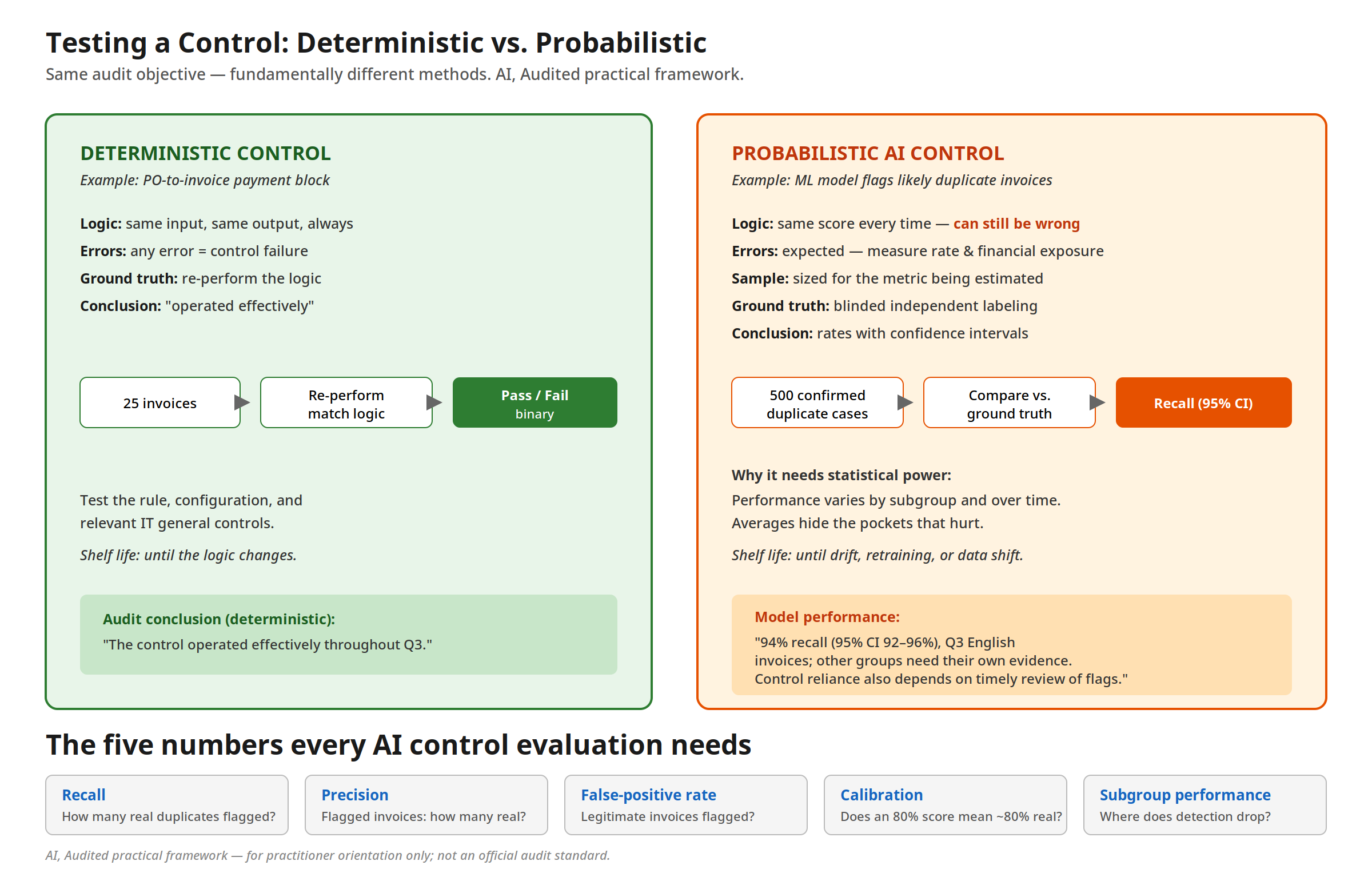
An IT auditor knows how to test an automated payment block. Take a purchase-order-to-invoice match. If the invoice amount exceeds the remaining approved PO amount beyond the configured tolerance, the system should block payment. You inspect the rule and its configuration, test cases on both sides of the tolerance, and verify that a blocked invoice cannot proceed through the normal payment workflow. To draw a conclusion for the quarter, you also need evidence about the rule and configuration in use during that period and the relevant IT general controls.
Now test an AI duplicate-invoice detector. It scores invoices against prior records and flags likely duplicates for review. It can miss a duplicate with a slightly different invoice number and flag a legitimate recurring charge. Rerunning the same invoice might give you exactly the same score. You still need to know how many real duplicates the model caught across the invoices it was meant to screen.
FIVE DIFFERENCES THAT MATTER
1. A repeatable score can still be wrong. A fixed model may give the same score for the same invoice and comparison records. The question is how reliably that score identifies real duplicates across the production population. If outputs can vary across repeated runs, test that variability separately.
2. Different errors have different consequences. A false positive adds to the review queue. A false negative may let a duplicate payment through. A missed high-dollar invoice can matter more than several unnecessary reviews, so examine the financial exposure as well as the error rates.
3. The claim determines the sample. To estimate recall, you need enough confirmed duplicates. To estimate precision, you need enough flagged invoices. Traditional controls sampling already accounts for sampling risk and tolerable deviations. Model evaluation adds a practical question about how to find enough cases for each metric.
4. Performance can change while the model stays the same. New vendors, invoice formats, or payment patterns can change what the model encounters. A model update or a new flagging threshold can also change which invoices reach the review queue.
5. You need independent evidence of what really happened. Reviewers can verify duplicates using invoice images, vendor records, and payment history. Keep the model’s flag hidden during labeling where feasible, document how ambiguous cases are resolved, and include unflagged invoices in the evaluation design.
WORKED COMPARISON
Suppose that accounts payable processed 12,000 invoices in Q3. The figures below are illustrative.
PO-to-invoice payment block
Verify the configured tolerance and test invoices below, at, and above the threshold. Confirm the payment block and test any authorized override path. Verify which configuration was in effect during Q3 and assess the relevant IT general controls. This supports a conclusion about whether the rule operated as configured during the period covered by the evidence.
AI duplicate-invoice detector
Compare production flags against independently verified duplicate cases, including cases the model missed. Measure recall at the production threshold and examine relevant subgroups, such as invoice language or format. This shows how reliably the model detected duplicates in the tested population.
Human review before payment
Trace flags from the model output into the review queue. Check whether reviewers acted before payment and documented how they resolved each case. This shows whether the review workflow acted on alerts in time to prevent duplicate payments. Suppose management requires at least 90% recall on eligible English-language invoices. In an independent evaluation, the model flagged 470 of 500 confirmed duplicate cases and missed the other 30. That gives 94% recall, with an approximate 95% confidence interval of 92% to 96% under a simple sampling design.
An audit conclusion could read as follows.
“At the production flagging threshold, the Q3 evidence supports the 90% recall criterion for eligible English-language invoices. Reliance on the full control also depends on whether flags reached reviewers and cases were resolved before payment. Other invoice-language groups require their own evidence before the same recall conclusion can be applied to them.”
HOW TO EVALUATE THE MODEL
1. Define the claim before testing. Write down the metric, minimum acceptable performance, population, period, and production threshold. The recall denominator includes all eligible confirmed duplicate cases in the evaluation sample, including those that scored below the flagging threshold. Decide in advance what evidence will support the conclusion that the model met the criterion.
2. Establish independent ground truth. Define what counts as a duplicate. Two invoices with different reference numbers may bill for the same delivery, while two invoices for the same amount may cover separate deliveries. Give qualified reviewers a labeling guide, keep model flags hidden during review where feasible, and document how disagreements are resolved. Use independently verified records to check the labels where available.
3. Size the sample for the metric. A common planning formula for estimating a proportion under simple sampling is n ≈ Z² × p(1 − p) / E². Here, p is the expected rate, E is the margin of error, and Z is 1.96 for 95% confidence. Estimating a 5% miss rate within ±2 percentage points takes about 457 confirmed duplicate cases under those assumptions. If duplicates are rare, a random draw of 457 invoices may yield very few duplicates. Plan separately for any subgroup you intend to report on. If you oversample certain groups, account for the sampling design when calculating the overall production estimate and its confidence interval.
4. Measure the errors that affect the control.
• Recall. Of the actual duplicates, how many did the model flag?
• Precision. Of the flagged invoices, how many were actual duplicates?
• False-positive rate. Of the legitimate invoices, how many were flagged?
• Calibration. If the score represents a probability of duplication, do invoices scored around 80% turn out to be duplicates about 80% of the time?
• Subgroup performance. Does detection drop for particular invoice formats, languages, or vendor groups? How much evidence supports each estimate?
5. Scope the conclusion and keep testing. Record the population, period, model version, threshold, and confidence intervals. Include what you found about routing, reviewer action, and exception handling. Set the monitoring cadence based on risk and how quickly the workflow changes. Reassess performance after material changes to the model, threshold, or invoice mix. Track alert volumes and review delays between evaluations, and periodically verify a sample of unflagged invoices to look for misses.
CHECKLIST FOR YOUR NEXT AI CONTROL AUDIT
• Management defined the performance claim, population, and production threshold before testing.
• The reference labels are independent of the model, and ambiguous cases are documented.
• The sample includes enough confirmed cases for each reported metric and subgroup.
• The evaluation covers flagged and unflagged invoices as required by the metrics.
• The threshold reflects the cost of missed payments and the team’s capacity to review alerts.
• Flags reach the right reviewer, and cases are resolved before payment.
• The workpapers record the model version, threshold, period, and limits of the conclusion.
• Monitoring has an owner, a schedule, and triggers for reassessment.
Start with one high-risk AI-assisted control. Ask the owner how many misses the business can tolerate, how those misses would be detected, and what happens to an alert before money moves. Those answers tell you what evidence to collect and what conclusion it can support.
SOURCES
• PCAOB AS 2315, Audit Sampling
https://pcaobus.org/oversight/standards/auditing-standards/details/AS2315
• NIST AI Risk Management Framework 1.0 and AI RMF Playbook, Measure
https://airc.nist.gov/airmf-resources/playbook/measure/
• Google Machine Learning Crash Course, Classification Metrics
https://developers.google.com/machine-learning/crash-course/classification/accuracy-precision-recall
• EU AI Act, Regulation (EU) 2024/1689, Articles 9 and 15
• ISO/IEC 42001:2023, AI management systems